


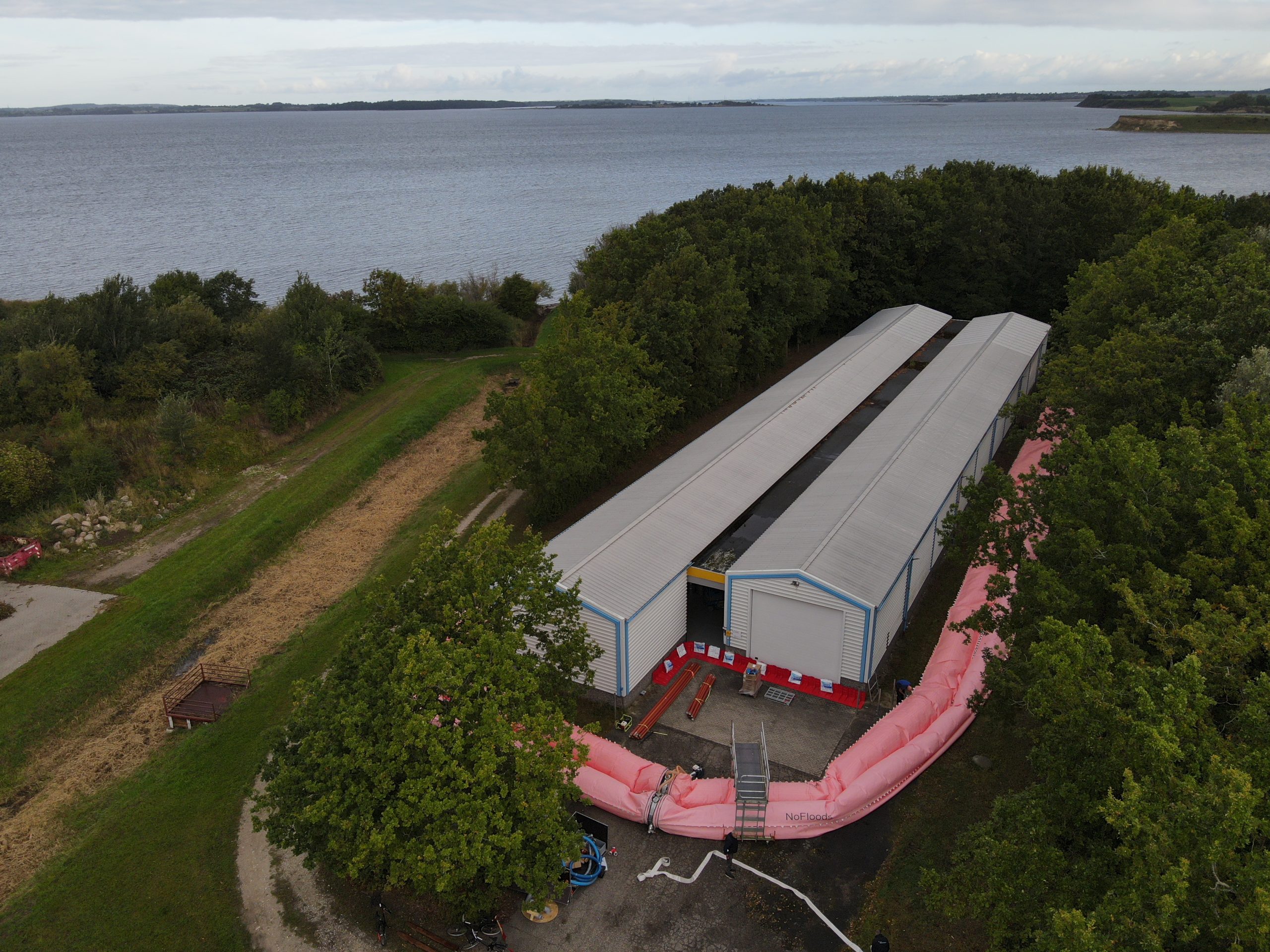
23 Sep Annual flood protection drills provide valuable experience
On Thursday, September 17, Dansk Dekommissionering’s flood response team conducted its annual drill.
EAn exercise in high tide and teamwork.
At 8:00 a.m., the flood response team at DDwas ready. The team consists of 11 employees, all of whom are trained to handle the tasks associated with flood protection for Building 244, also known as the low- storage facility. In the event of a potential rise in water levels, six employees are required to implement the flood protection measures.
On a day-to-day basis, the employees perform other duties at DD, but they are also part of the emergency response team that can be activated when a high-water warning is issued.
This means that employees who do not normally work closely together must be able to collaborate effectively and complete the task as a unified team.
The exercise demonstrated that the emergency response team is well prepared. The deployment of water hoses and the other tasks involved in securing the warehouse were completed in less than 60 minutes. This is a testament to effective cooperation, a clear division of roles, and a high level of efficiency.
At the same time, the exercise provides a clear indication of the emergency response system’s ability to react. According to the Danish Meteorological Institute (DMI), warnings of high tides or storm surges are typically issued 1–3 days before the event. DD thus has ample time to put the necessary safety measures in place should the situation arise.
Storm Bodil led to the establishment of the flood preparedness plan at
It was particularly Storm Bodil, which struck Denmark in 2013, that highlighted the need for a local flood preparedness plan at DD. As a result, DD established its own preparedness plan in 2014.
Since then, the emergency response team has conducted annual drills to ensure that procedures, equipment, and coordination function as intended.
During Storm Bodil, the water level in Roskilde Fjord rose to 2.06 m above mean sea level and was approximately 40 cm from floor level in the warehouse.
The installation of water tubes will protect the warehouse against a water level rise of 3.06 meters. Specifically, this involves a double water tube approximately 200 meters long.
The temporary storage facility with water tubes is a stopgap measure. In the long term, all waste will be stored in the new, upgraded “ storage facility ” (NOL). This “ storage facility ” will be built with a floor elevation of over 4 meters and is intended to house Denmark’s radioactive waste until no later than 2073, when a final repository is scheduled to be completed.
Valuable knowledge and valuable experience
Kenn-Ulrik Brix Sørensen, who was in charge of DD’s flood preparedness, talks about the drill:
“Practicing our emergency response procedures provides us witha wealth of practical experience and valuable knowledge. Once again this year, I can confirm that our skilled staff carry out their duties to the highest standards and are both thorough and capable in ensuring our storage facility.”
Facts About Low-Level Radioactivity storage facility
The low-level radioactive waste facility storage facility contains approximately 5,500 drums.
The drums typically consist of an inner metal drum with a capacity of approximately 100 liters, housed inside an outer metal drum with a capacity of 220 liters. Between the two drums, there is a layer of approximately 5 cm of concrete for additional shielding.
The storage facility is continuously monitored for both safety and radiation.