


March 04 Cold Solution to an Environmental Challenge
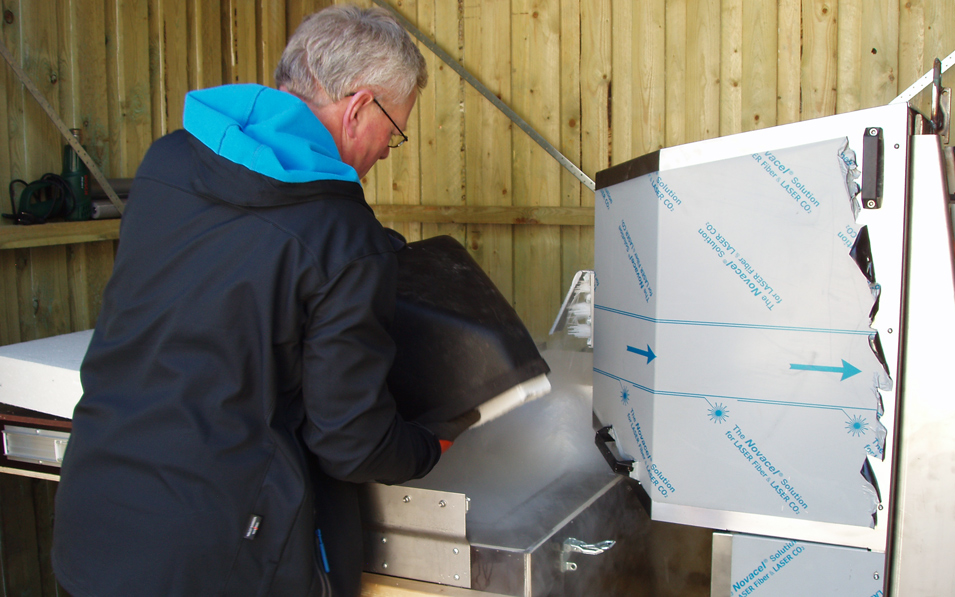
When Project Engineer Morten Dalby wakes up at 5 AM, he immediately grabs his mobile phone to remotely start Danish Decommissioning's very own ice machine. A few hours later, a large box of dry ice is ready on the Risø peninsula for the removal of environmentally hazardous paint.
DDuring the construction of the Risø Atomic Research Centre in the late 1950s, the most advanced paints of that era were applied to both equipment and interior building structures. This paint was characterized by its flexibility, colorfastness, and durability, yet it contained the now-prohibited substances: PCBs, lead, and mercury.
This presented the project team responsible for dismantling the DR 3 reactor and associated facilities with something of a headache. What is the best way to clean up environmentally hazardous and radioactive paint, taking into account both work environment the future storage of the waste?
Following a series of experiments, a somewhat unconventional method has been chosen: ice blasting. Three-millimeter-thick rods of CO2 ice (dry ice) are propelled against the paint. The sudden cooling renders the paint stiff and brittle, allowing it to detach more easily as the stream of -79 degree Celsius cold ice rods continuously impacts the surface.
The cooling is also beneficial for work environment employees' work environment, as the paint is too cold to emit toxic gases.
Furthermore, ice blasting offers a distinct advantage in terms of waste management: it leaves behind only the removed, radioactive paint for future disposal. A traditional cleaning method, such as sandblasting, would generate a large volume of secondary waste that would also require disposal.
When dry ice is heated, it undergoes a direct phase transition from solid to gas. During ice blasting, the CO2 gas is extracted through the ventilation system, which is equipped with filters and radiological monitoring, while the paint is vacuumed into a sealed, shielded package.
To provide employees with a certain flexibility in the cleaning work, Danish Decommissioning has chosen to invest in an ice machine rather than purchasing dry ice externally. Morten Dalby conceived the idea for their own ice machine during a run in Risø's beautiful natural surroundings:
“Quite by chance, I came across a CO2 tank that DTU uses for experiments with crops. It subsequently turned out that DTU only uses the tank during the growing season from April to August, so we have now installed an ice machine next to the tank and use it during the other months.”
The CO2 used in the ice blasting machine is sourced from a supplier in Sweden – where it is, incidentally, a byproduct of vodka production.