


27 Feb The Newly Qualified Health Physicists
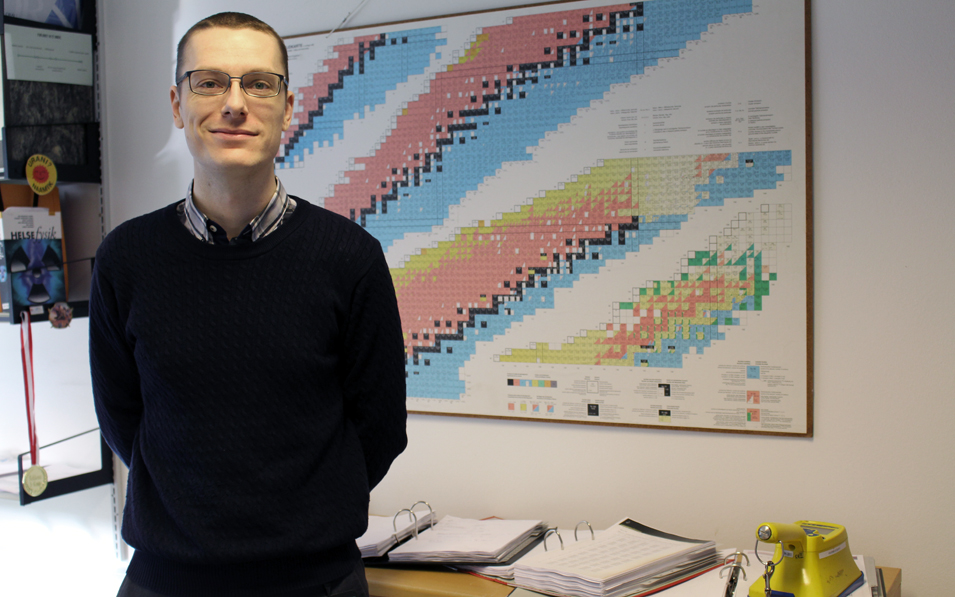
Danish Decommissioning has gained two qualified health physicists at the start of 2017. Mikkel Øberg, along with Quang Le, has completed the one-year internal training program.
“I have always wanted to work with radiation and dosimetry in practice and not just sit and research alone in a basement. As a health physicist, you work to protect people from radiation in their work environment, and you are also an advisor, communicator, and educator,” explains Mikkel Øberg.
Unlike countries with nuclear power, Denmark does not have a certified training program for health physicists. Instead, the Section for Radiation and Nuclear Safety develops a training plan for aspiring health physicists who possess a foundational education as either an engineer or a physicist.
Study Groups, Exercises, and Courses
The major part of the training takes place as a study group with experienced health physicists and sometimes also the operations manager of the health physics laboratory. A broad spectrum of topics is discussed comprehensively, and materials are exchanged.
The theory is supplemented by a wide range of exercises and assignments, which are subsequently reviewed. These may include calculation tasks concerning, for instance, the generation of and shielding against bremsstrahlung X-rays from beta sources, or the consequences of radioactive substance releases into the surrounding environment. It can also involve laboratory exercises where various measuring equipment needs to be calibrated, or where measurements are taken to determine if decommissioning waste with low levels of radioactive substances can be released.
The internal component of the training is supplemented by external courses as relevant. Quang Le has completed an eight-week course on Radioactive Isotopes and Ionizing Radiation at the University of Copenhagen, as well as DANAK’s Basic Course for Assessors (a course required for DD’s accredited release function).
“The courses Quang took, I had already completed through my previous employment and my education as a civil engineer in medicine and technology. So instead, I took the Applied Health Physics course at Oak Ridge Associated Universities in Tennessee. This is a five-week course that is part of the USA’s requirements for certified health physicists,” says Mikkel Øberg.
The Internal Opportunity
Both Quang Le and Mikkel Øberg were recruited internally and came from engineering positions.
“My entire education has been geared towards working at Risø. I previously applied for one of DD’s health physicist positions but instead got a job as an operations engineer here in 2014. I worked with our waste database for a few years, and when health physicist positions were advertised again, I immediately applied,” explains Mikkel Øberg.
Now that the training period is successfully completed, both newly qualified health physicists are part of DD’s 24-hour emergency response team. As the on-call health physicist, one is summoned if, for example, a fire alarm sounds at the nuclear facilities or if other incidents and accidents occur that could involve radioactive substances.