


12 Jan Relocation of the work deck in DR3
Danish Decommissioning undertakes continuous tasks that are unique to its field, one of which involves the relocation of the more than 60-year-old work decks within Danish Reactor 3 (DR3).
Working within a former research reactor is inherently a unique and, in many respects, specialized task, imposing distinct and specific requirements.
Combining this unique operational framework with a massive steel deck, comprising over 120 components that must be disassembled, lowered, and reassembled, results in a task of a kind rarely encountered globally.
Rationale for the Work Deck Relocation
Since 2021, Jonas Bie Mahler has served as project manager for the Decommissioning of DR3, Denmark's largest research reactor, overseeing both its physical and energetic aspects.
This process has been underway since the establishment of Danish Decommissioning 19 years ago, in 2003, with the relocation of the work deck being one of the numerous associated tasks.
Currently, the Decommissioning of DR3 is at a stage involving the cutting of the concrete that enveloped the reactor core, technically referred to as the reactor block. This block comprises, among other materials, several meters of thick concrete, originally infused with steel spheres to enhance its density and shielding against radioactive radiation, and is being sectioned into large pieces using saw blades.
It is an extensive process, and fundamental to this process is the necessity for work to be conducted on a stable and durable platform, which is where the work deck becomes essential.
This work deck has been retained due to the clear advantages it provides for the Decommissioning of DR3.
“The deck in DR3 has been an integral part of the reactor's original design. Consequently, it has been a logical choice for us to utilize it as a working platform, rather than demolishing and decommissioning it, and then working with scaffolding,” explains Jonas Bie Mahler.
The Decommissioning of DR3 has now progressed to the point where the work deck must be lowered further to facilitate additional cutting of the reactor block; however, the relocation itself is also a time-consuming process.
How the Work Deck is Relocated
To comprehend the dimensions and design of the work deck, it is essential to understand the original intent behind its construction.
Jonas Bie Mahler explains: “The deck was designed to accommodate our transport flasks, each weighing 23 tons, occupying approximately 1 square meter of floor space, and standing over 4 meters tall. Thus, it is a very robustly constructed deck, featuring massive beams. Compared to its current use, it is indeed significantly over-dimensioned, but this provides substantial stability.”
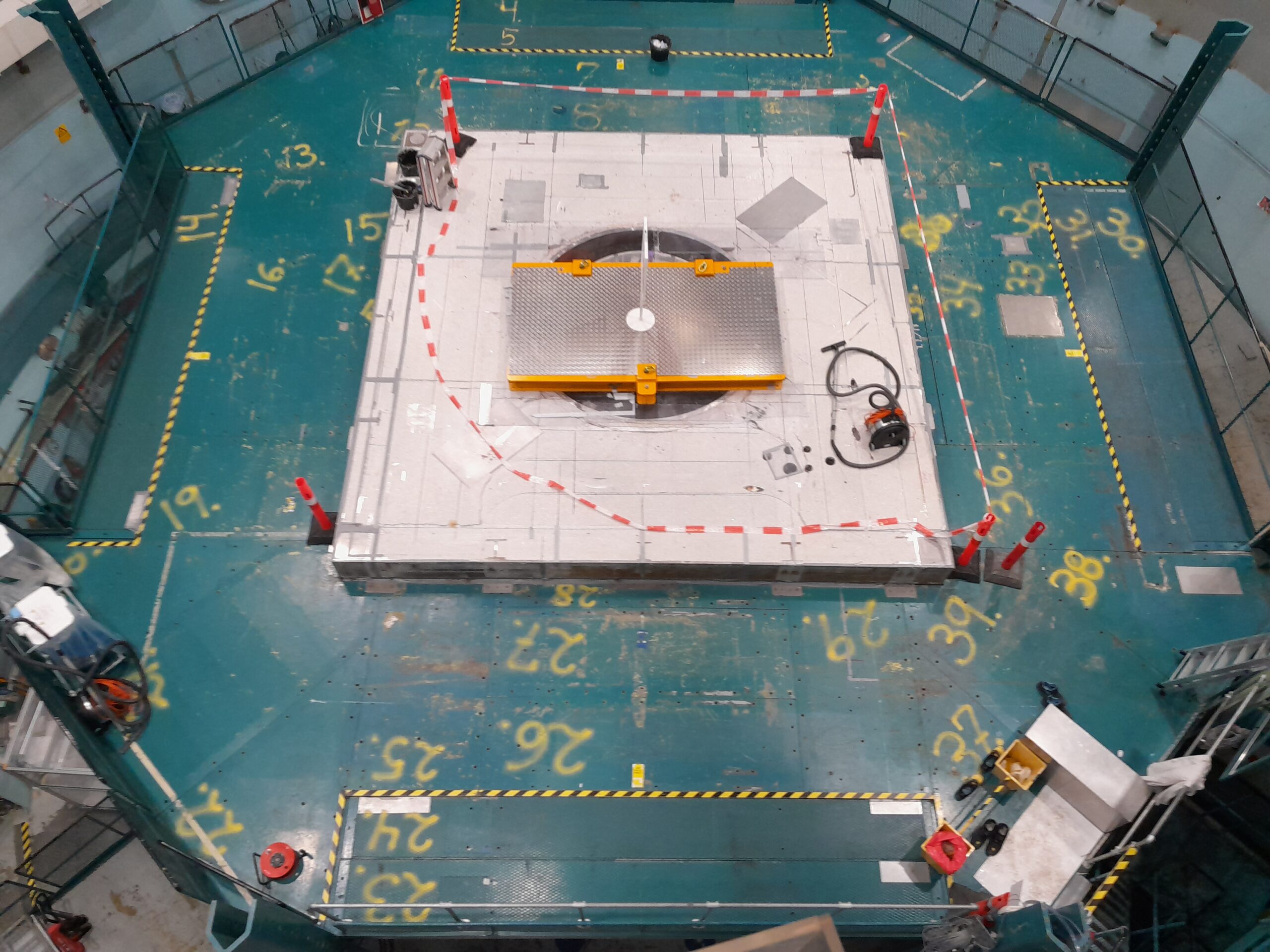
The work deck itself is constructed from a type of bracket system, which is mounted onto the reactor block using a bracket with various levels. Massive steel beams are then placed on these brackets and secured to steel columns anchored to the floor. Finally, 39 plates are positioned atop the steel beams, collectively forming the working surface.
The operation itself is not necessarily overly complicated, provided the drawings and methodology are well-understood, but it is extensive and time-consuming.
“To relocate the work deck, the bracket system must be removed, which necessitates complete disassembly. The deck cannot be partially lowered, nor can individual sections be lowered independently; the entire structure must be disassembled. This requires significant space and is time-consuming,” Jonas Bie Mahler explains.
Challenges Arise Continuously
Rune Duelund Nielsen is one of the craftsmen who regularly works inside the former research reactor and is now, for the second time during his tenure at Danish Decommissioning, involved in relocating the work deck.
Rune Duelund Nielsen himself is one of the most crucial resources in planning the relocation of DR3, as he has previously participated in its relocation, and in addition to the work deck's drawings, his practical experience and knowledge are extremely valuable.
Consequently, Rune Duelund Nielsen is also familiar with the challenges that may arise continuously throughout the process and how these can be mitigated.
“The last time we relocated the deck, we observed that one of the significant challenges encountered was the decision to paint the deck with a rather robust paint containing PCBs and lead. This had the effect that all the 'open' holes, to which the deck was to be lowered and secured, had their threads painted over and their diameters altered. Consequently, we had to re-grind all threads and holes at that time to ensure proper fit. This grinding process, naturally, also imposed specific requirements for occupational safety when working with PCBs and lead.”
In the same category of challenges, it was also observed at the time that since the work deck had not been relocated for over 40 years, some bolts and joints had become severely seized, requiring innovative solutions for their release.
Another practical challenge in executing the task, intrinsically linked to planning, is that the entire operation takes place in a relatively confined space. When the work deck is relocated, the largest staging area in DR3 is simultaneously lost, necessitating creative solutions for disassembling and positioning the deck components throughout the facility. However, it is crucial that components are positioned to remain accessible when the work deck is reassembled, thereby avoiding unnecessary time spent relocating items.
In this context, the specialized ring crane, known in English as a polar crane, plays a pivotal role, but it is also one of the elements that can present challenges.
“Unfortunately, we have now experienced that the crane required a repair during the process and consequently has not been able to operate stably. This halts the entire process during the crane's downtime, as it is crucial for lifting the work deck's components.”
A final critical aspect that is consistently prioritized during the relocation is occupational safety. This is not a challenge in itself; on the contrary, it is of paramount importance. However, when working with such heavy components and large machinery, as is the case with this relocation, and simultaneously at heights requiring fall protection, it naturally necessitates continuous adjustments to ensure that safety is not compromised.
Things Take Time
The relocation of the work deck itself is scheduled for a duration of four effective working weeks, but as with all planning, this represents a balance between optimal efficiency and an integrated buffer.
Looking ahead to the next instance when the deck will be relocated or perhaps entirely removed, Jonas Bie Mahler does not anticipate another two-year interval.
“We have become significantly faster and far more efficient in the execution phase of cutting the reactor block. We have optimized many aspects, for instance, by being able to operate with two saws compared to one previously, and we hope to avoid external factors such as the Corona lockdown in the future.”
Furthermore, he cites ventilation, larger cutting enclosures, and experience with the equipment as contributing factors to the significantly faster pace of reactor block cutting operations today compared to before.
However, Jonas Bie Mahler is also aware that the further one progresses in the overall Decommissioning process of the entire DR3, the greater the complexity becomes.
“It only becomes more challenging the further we advance in the process.”
For now, the focus is on the relocation of the work deck in DR3 before Danish Decommissioning can resume the Decommissioning of Denmark's largest research reactor.


