


17 Sep Extensive cleanup of the powder room
Concrete dust, grinding machines, and full-body suits. Much of the time, decommissioning resembles a rather ordinary, yet intensive, renovation. The powder room, where Risø processed uranium for fuel rods, has been thoroughly ground down on all surfaces.
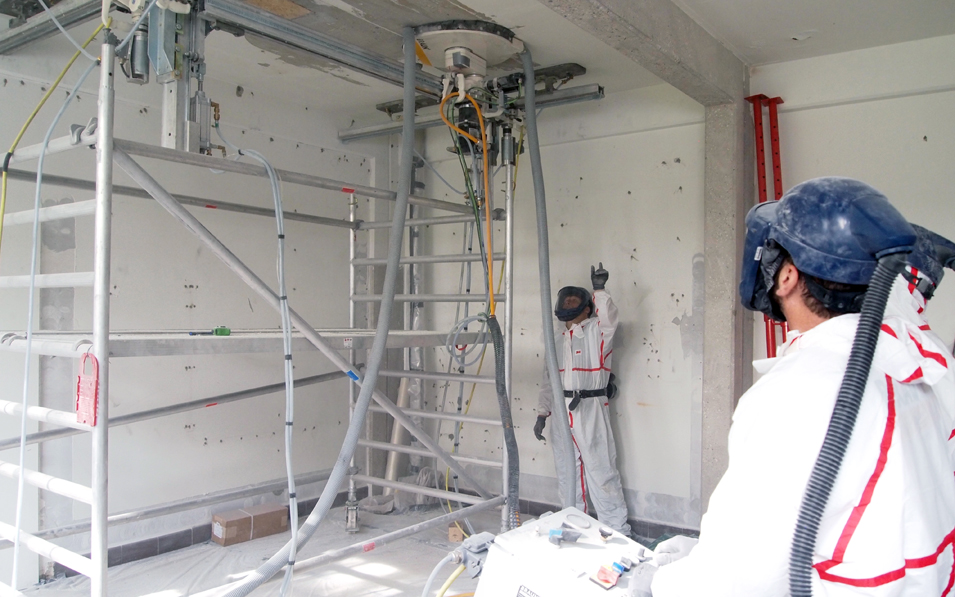
TThe room is hazy with concrete dust, and grinding machines roar through ear protection and masks. Here, in the former powder room, uranium powder was meticulously measured for decades. The uranium was pressed into pellets and rolled into plates, which became fuel rods for Denmark's largest research reactor. Now, the entire room is covered with a thick layer of moon dust, bearing traces of wheels and protective shoe covers.
Uranium powder is as fine as icing sugar, and years of handling the powder may have dispersed uranium dust throughout the room. When fuel production ceased in 2000, the room was surveyed for radioactivity, and all surfaces were painted over. Our project personnel were prepared for the possibility that the room might be contaminated behind the paint. Therefore, DD’s craftsmen are grinding down all surfaces in the room and removing the floor covering.
Access to the powder room is through a double-door airlock, where all employees are dressed in overalls, masks, gloves, and overshoes before being permitted to enter the dusty environment. The ceiling was first ground with a remote-controlled machine mounted on rails. Subsequently, it was further processed with a long-reach sander. The dust is extracted using a specialized vacuum cleaner, and both the dust and the vacuum cleaner are measured for radioactivity.
A thorough measurement of the entire room is required before we can be certain that no traces of radioactivity remain. Once the powder room has been fully ground, all surfaces are therefore measured by DD’s release function, which comprises specially trained personnel from, among others, the Radiation and Nuclear Safety section. This work is performed using a handheld measuring instrument, which we refer to as a CoMo – a contamination monitor.
Fortunately, as the work progresses, it has been revealed that there is limited contamination in the walls and ceilings. The workbench where Risø's laboratory technicians measured uranium powder has been removed, and a drain in the floor beneath was contaminated, necessitating the drilling out of the entire drain well. The room's drainage and ventilation systems must also be cleaned and checked before the room can be released.