


06 Mar Work on the Fuel fabrication plant completed
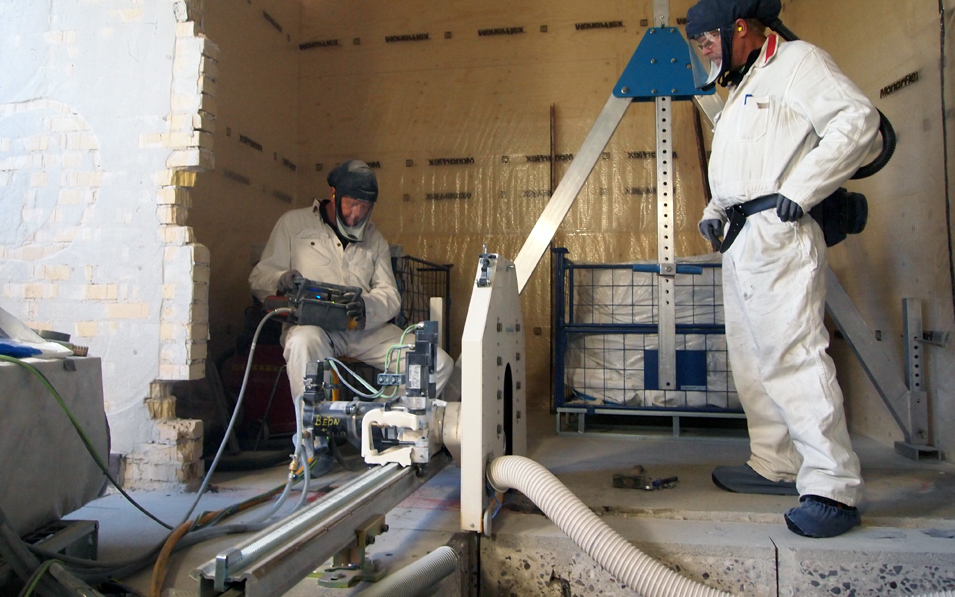
After more than a year of grinding and dismantling work, DD’s craftsmen have now moved out of the Fuel fabrication plant.
WWithin the Fuel fabrication plant, Risø Research Centre produced fuel rods from 1960 to 2002. This fuel powered both the DR 2 and DR 3 reactors. Personnel in the Fuel fabrication plant measured uranium powder, pressed it into pellets, and then rolled these into thin plates encapsulated in aluminum. These plates were subsequently cleaned, degreased, and ultimately formed into cylinders. Production activities occurred in various rooms, which have now undergone decontamination.
It has been a larger task with the fuel fabrication plant than originally assumed. In fact, cleaning the building should have been quite limited because we knew what each room had been used for. We dismantled tables, cleaning vessels and ventilation in the various areas, and then we cleaned the walls, floors and ceilings with knuckle grease and grinding machines to remove all old traces of uranium. This meant that the task should be solved.
However, it was not that straightforward. During the process, small spots of radioactive material were discovered when our health assistants inspected the building. Our craftsmen had to re-don their workwear multiple times because traces of uranium were still detectable. A series of concrete floor samples were thoroughly examined in our laboratories.
The work on the Fuel fabrication plant demonstrates why we place such emphasis on control and measurements, even if it is time-consuming. Radioactive substances cannot be seen or felt, making it necessary to use highly sensitive equipment for detection. It typically takes several weeks to measure a sample for uranium, as uranium radiation is low-energy, and naturally occurring uranium is ubiquitous – even beneath our laboratory. We refer to it as a release measurement when an object is measured to have such a low activity content that it can be used elsewhere without restrictions.
However, the final chapter has not yet been closed. Before we can finally transfer the Fuel fabrication plant to the Danish Building and Property Agency, which owns it, we must complete a final report. We anticipate completing this during the spring. Subsequently, the final report must be approved by the nuclear regulatory authorities.