


10 Jun The great waste puzzle
A significant part of the work involved in dismantling the old nuclear facilities is the packaging of radioactive waste into containers. Optimal utilization of space within each container is crucial, requiring both ingenuity and meticulous planning to complete this intricate task.
I“It is crucial to avoid voids,” explains Per Søndergaard, project manager for the dismantling of the DR 3 reactor:
“Our objective is to minimize the volume of the waste. Furthermore, compactly packed containers also reduce the risk of water ingress and subsequent leaching of radioactivity into the environment.”
In the autumn of 2014, a 17-ton, 2.5-meter-wide shielding ring was lifted from its position around the top of the DR 3 reactor tank. Since then, the ring has rested in a large container, and the DR 3 team is now utilizing the space within and around the ring.
“First, we had some triangular frames custom-made for the four corners. Within these, we have placed several pipes that were mounted on top of the fuel elements,” says Per Søndergaard, continuing: “We are now in the process of creating some moon-shaped containers to be placed inside the ring. These will be filled with pipes and other materials from experiments. And at the center of it all will be a cylinder containing fragments of thin steel rods that have absorbed a significant amount of radiation.”
When planning this arrangement, consideration must be given to the waste's shape, size, and weight. Furthermore, the different material types must interact such that less active materials shield the more active ones, ensuring the total radiation from the container does not exceed permissible limits.
A Sarcophagus in the Container
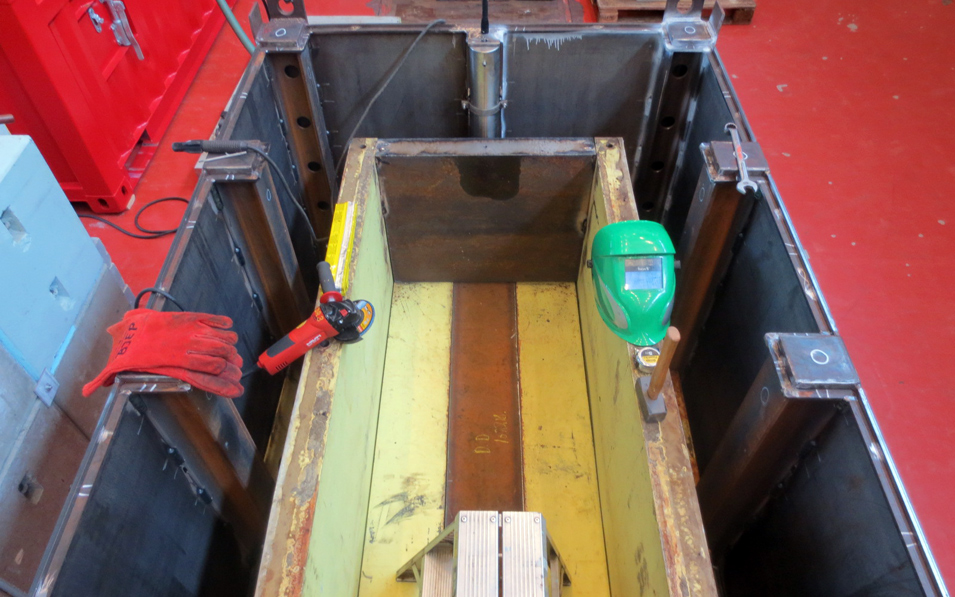
The next major step in the dismantling of the DR 3 reactor involves cutting up the inner tank and placing its fragments into containers. One container has been prepared to receive the inner tank's most active component: a grid located at the bottom that held the fuel element pipes in place.
The grid will be laid to rest in a yellow iron sarcophagus, which is itself radioactive waste. It was previously used for shielding in the heavy water room and can now be repurposed as shielding material. However, the DR 3 team had to cut down the sarcophagus's thick iron lid to fit it into the container.
“We prioritize recycling, both to save costs and to avoid generating additional radioactive waste. For instance, the saw we use to cut through thick iron was acquired at a low cost because it was already slightly contaminated from cutting radioactive materials,” says Per Søndergaard with satisfaction in his voice.