


17 Dec The outer parts of the reactor are next in line
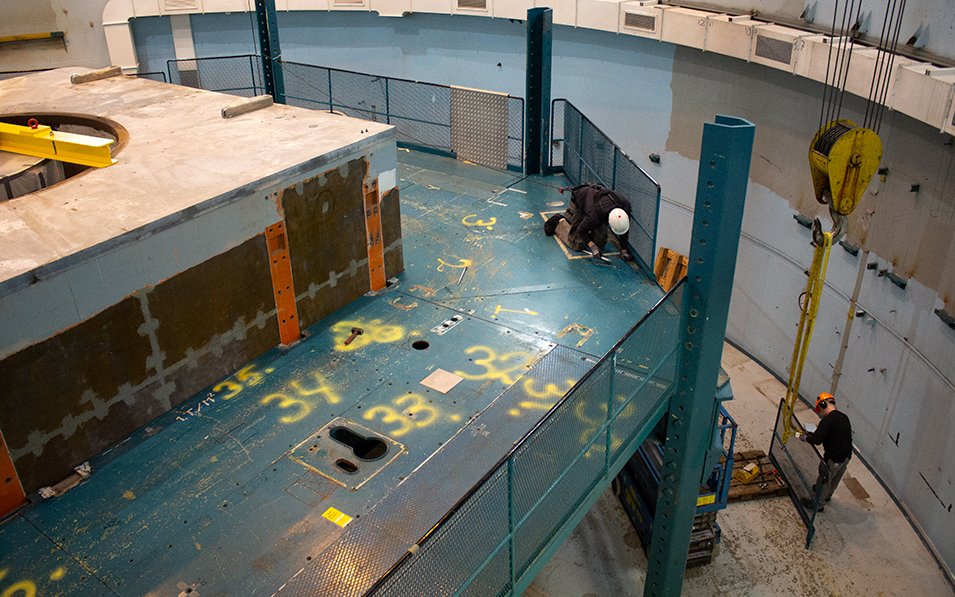
The upper section of Danish Reactor 3 now stands exposed and bare, ready for dismantling. As a final preparation, a working platform has been removed from the top of the reactor block and reassembled in a lower position.
BBy the beginning of 2019, the reactor's internal components – the reactor tank itself, a graphite reflector, and an associated lead layer – had been cut up, removed, and packed into containers (see more here). The subsequent months have been dedicated to clearing and cleaning up after this work and preparing for the next phase, the dismantling of the outer components.
First, the transparent housing, which was built in 2015 on top of the reactor's movable lid, was dismantled. The housing's two airtight plexiglass chambers contained, respectively, a manipulator arm and a crane, which had been used for remote-controlled operations, but this equipment was not required for the next phase.
Once the movable lid was freed from its overlying housing, it was disconnected from all systems and disassembled. Beneath it were an old reactor ring and a previous plug, both of which had to be removed. In their place, a new, movable plug was inserted, designed to provide shielding during the cutting of the reactor's outer components.
At the base of the reactor stood a control trolley, from which personnel had operated the remote-controlled equipment. This trolley was subsequently decontaminated and moved outside. Overall, all removed elements were decontaminated as much as possible, but some had to be retained as waste.
Following a thorough cleanup and decontamination of the reactor building, it was time to remove four large metal cylinders – the final components to be extracted from the reactor block's concrete prior to cutting. Each cylinder contained ion chambers that, during operation, had measured the reactor's flux (ionization per unit of time).
As the final significant step in this phase, the access deck surrounding the top of the reactor block has just been lowered. It was originally conceived as a movable deck that could be raised and lowered as needed, but in reality, it had never moved so much as a single centimeter – until now. A crane lifted the numbered deck plates away, after which the brackets and supporting elements were lowered by approximately one and a half meters, and the deck plates were then repositioned. However, considerable adjustment was required to align the 60-year-old structure correctly, but now the uppermost section of the reactor block is exposed and ready for the next phase.
Watch half a year's work of clearing the reactor top, compressed into less than three minutes (Note: The video is without sound):