


20 Apr New Generation of Health Physicists
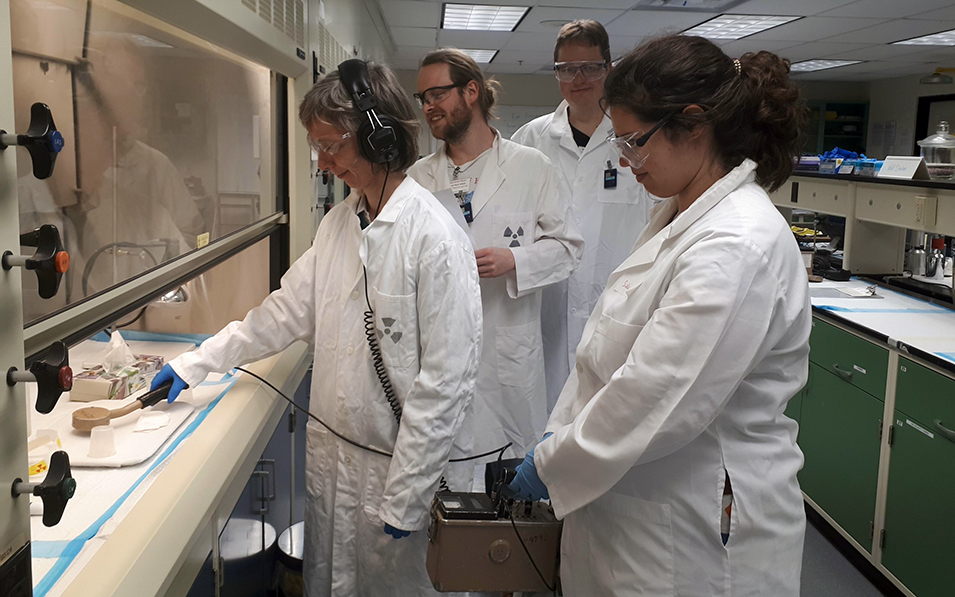
For an organization centered on the management of radioactive materials, it is essential to possess robust expertise in radiation protection. Consequently, DD recruited four new employees at the beginning of the year, who are now undergoing training as health physicists.
“As a health physicist, you work to protect people from radiation in their work environment, and you also act as an advisor, communicator, and instructor,” explains Mikkel Øberg, who completed the training himself just over five years ago and this November became the new head of the Radiation Protection unit. He succeeded Per Hedemann Jensen, who celebrated his 50th anniversary at Risø last year.
Unlike countries with nuclear power, Denmark lacks a certified educational program in this field. Instead, a tailored training plan is developed for the aspiring health physicists, who typically hold a foundational degree as either an engineer or a physicist. The predominant part of this training is conducted internally, where seasoned colleagues facilitate study groups, practical exercises, and assignments, complemented by external courses as deemed necessary.
The four aspiring health physicists have just returned from the ”Applied Health Physics” course at Oak Ridge Associated Universities in Tennessee.
“In Oak Ridge, one truly senses the historical significance. During World War II, the city served as a central hub for uranium enrichment, and it genuinely embraces its history with pride, for instance, by featuring atomic-themed decorations on its buildings,” explains Claus Højgård Nielsen, one of the four participants.
Since 1947, the city's university has offered courses in health physics, thereby enabling the development of substantial capacity in both equipment and instructional staff over many years. The five-week ”Applied Health Physics” course is highly sought after by both American and international professionals who require comprehensive knowledge of radiation protection for their work in fields such as nuclear power, decommissioning, environmental protection, regulatory compliance, and healthcare.
“In the USA, the nuclear industry is exceptionally vast, allowing us to be instructed by experts from diverse branches of health physics. They each offered their unique perspective on the subject matter, effectively interspersed with humor,” states Marie Lund Traulsen, adding: “Overall, it has been highly beneficial to establish connections within a larger community of health physicists. This network will undoubtedly prove invaluable to us in the future.”
“The university’s laboratory equipment was also state-of-the-art, and staff members were readily available to address our numerous inquiries,” explains Frederik Storm Mahler, further supported by Claus Højgård Nielsen, who states: “All the measurements that we typically only encounter theoretically in Denmark, we were actually able to perform hands-on there.”
The four Danish participants, alongside individuals from the USA and Saudi Arabia, comprised a smaller cohort of only 11 attendees. While a typical cohort consists of 20 participants, the reduced number of local attendees due to the pandemic provided the distinct advantage of increased individual attention.
Four boxes filled with binders containing educational materials are now en route from Oak Ridge to Risø. Back in Denmark, the aspirants' training will continue, with their examination scheduled for the autumn.
“I am very pleased that there are four of us undertaking this journey together – the training has evolved into a collaborative project rather than a competition. When faced with a challenging concept, almost invariably one or two of us will have comprehended it and can elucidate it to the others. And if none of us fully grasp it and require further clarification, well, that in itself is quite reassuring,” smiles Sidse Lærke Lolk.