


21 Feb The only ones of their kind
The only health assistants in Denmark are employed by Danish Decommissioning, a unique role within a unique workplace.
The sun has slowly set over the characteristic silver poplars, which rise several meters along the avenue leading to Danish Decommissioning at the scenic Risø.
For most employees at Risø, the sunset over Roskilde Fjord in February typically signifies the end of the workday. However, today, the sunset means the opposite for Christian, who, in the day's last rays, parks his car outside Building 214, the headquarters of Danish Decommissioning.
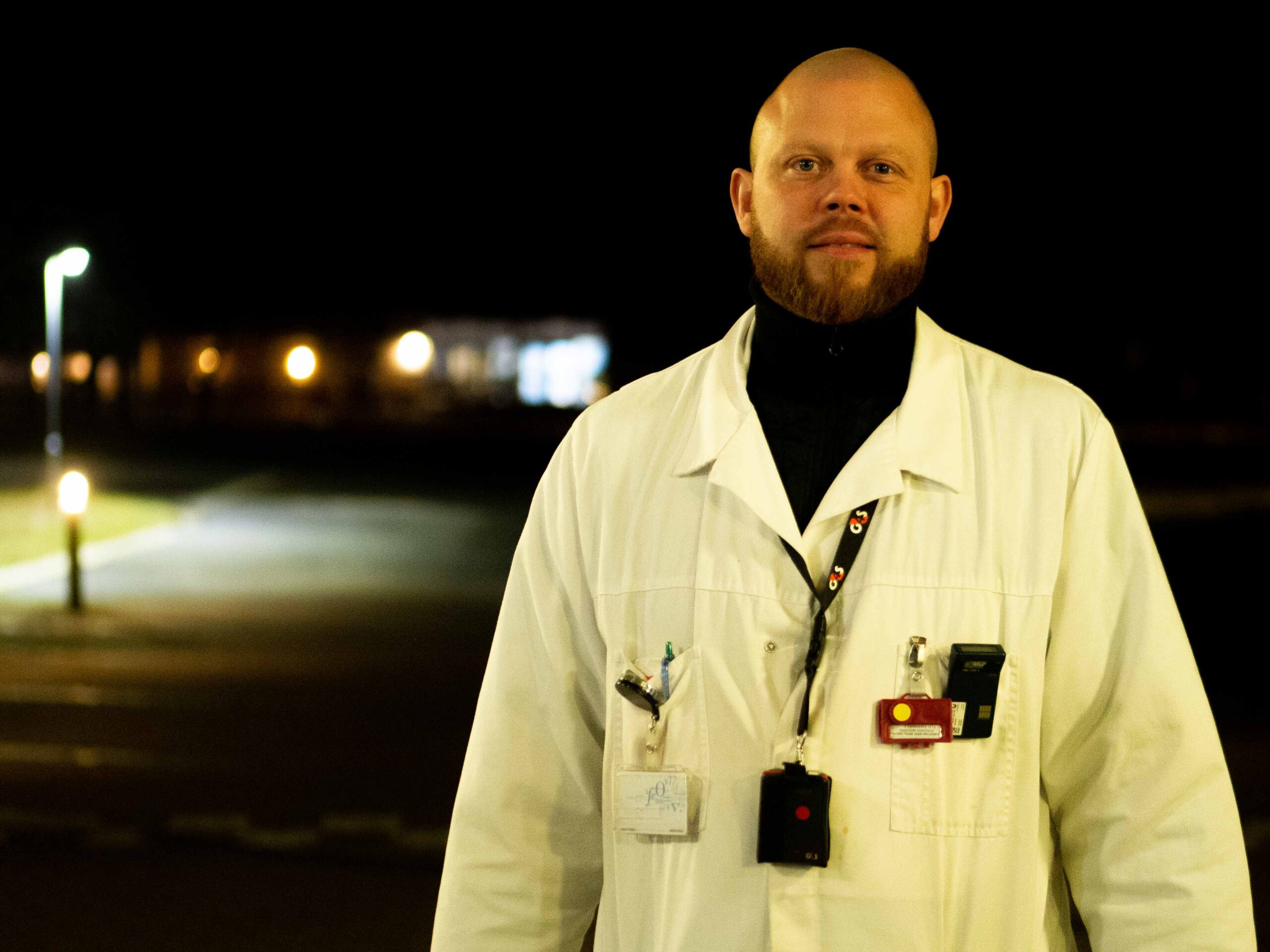
Christian is a Health Assistant at Danish Decommissioning, a role exclusively found there, and one that must always be present at nuclear facilities in Denmark.
The Health Assistants at Danish Decommissioning are approved as Radiation Protection Coordinators by SIS, the Department of Radiation Protection within The Danish Health Authority.
Health Assistant at DD
Christian dons his 'uniform', consisting of a lab coat and safety shoes. Attached to the lab coat are both a so-called MGP – an electronic dosimeter – and a TL (thermoluminescence) dosimeter, for recording and measuring external radiation exposure. In one pocket are two duty phones, and his breast pocket is filled with small, round, cotton-pad-like items used for taking wipe tests, known as 'smear tests'.
Christian has been a Health Assistant at Danish Decommissioning for the past 3 years, and his path to this unique role first led him through military service and subsequently an environmental technology education.
“One day I saw the job advertisement and found the prospect of working at the Risø site intriguing; it has a certain mystique about it. At least it did for me. My mother also worked there previously, so it’s not that mysterious, but I still found it exciting.”
After a job interview, Christian was ready to embark on a 6-month training program at Danish Decommissioning. Regardless of their background, all Health Assistants at Danish Decommissioning must undergo 6 months of training focused on radiation protection before they can join the 'duty roster'.
“Initially, I was a bit apprehensive about the prospect of returning to school for 6 months, but once the training began and I could relate it to the reality of the work here, I truly learned a great deal from it.”
A Solitary Beginning
As fate would have it, when Christian completed his training as a Health Assistant, the world looked quite different.
The COVID-19 pandemic was in full swing, and Danish Decommissioning, like other public workplaces, had sent its employees home, which led to a rather peculiar start in a job that is already unique in many ways.
“It's no secret that one needs to get used to working evenings/nights, to begin with. Combined with the pandemic, it was, of course, very unique.
However, I also work during hours when others are present, so I do have a relationship with my colleagues in the team, even though for me, in my role, it's probably a bit different from most 8-4 jobs.”
In addition to his colleagues at Danish Decommissioning, the on-duty Health Assistant also collaborates with Risø's gate guard, who is present on site at all hours of the day, every day of the year.
Safety in Routines
The role of the on-duty Health Assistant is fundamentally about safety. This includes ensuring that personnel are present on the site where Denmark's radioactive waste is stored, in case of an incident. It also involves ensuring that radiation levels and radioactivity in and around the waste are constantly monitored, so that no leak can occur undetected.
In many ways, the role can be compared to that of a firefighter who, for most of the time, hopefully does not need to take action.
Beyond being able to act in an emergency situation, more routine tasks constitute a significant part of a Health Assistant's portfolio.
Every week, the same tests and samples must be taken, and the same areas inspected. Alarms and measuring devices must be checked, and equipment needs fluid refills and maintenance. For example, Health Assistants conduct analyses at Danish Decommissioning's isotope laboratory.
“We have a sheet with tasks that we must complete during a shift, where one signs off and ensures that it is done. Additionally, there are daily-specific tasks that vary throughout the week. This ensures that we don't overlook anything and that we are consistently diligent in completing the tasks required for a shift,” Christian explains.
In addition to routine tests, the Health Assistant also contributes to continuous site monitoring, and to assist, the on-duty Health Assistant has their aforementioned devices, which are always carried around the site, as well as various computers and other alarm systems.
Always on Site
As mentioned, at Danish Decommissioning, Health Assistants are always present on site, with several during normal working hours from 8 AM to 4 PM.
This is because Health Assistants at Danish Decommissioning are tasked with monitoring and advising on radiation protection matters during work in classified areas, as well as measuring both internal and external waste. In other words, they are a central part of the entire task of decommissioning nuclear facilities and receiving external radioactive waste.
Particularly concerning the waste generated as a consequence of the decommissioning of the nuclear facilities at Risø, it is crucial that Health Assistants can categorize the waste and measure the levels of radioactivity it contains. However, even before a decommissioning task, Health Assistants participate in measuring dose rates (external radiation) and contamination levels on items or premises, thereby contributing to how the specific task can be resolved.
In addition to measuring waste and areas, Health Assistants also measure individuals leaving the special 'classified areas' to ensure they do not carry unwanted contamination out of the area.
Therefore, in Christian's case, it involves being an 'on-duty Health Assistant', a role that differs from a Health Assistant's daytime responsibilities but fundamentally shares the same purpose: to contribute to the optimization of radiation protection.
Off Duty the Next Morning
The next morning, Christian can hand over the two phones to 'the technical duty officer' and a Health Assistant colleague, respectively, and if everything has proceeded as planned, drive home and enjoy his time off.
Until he is scheduled to report for duty again, alongside his other Health Assistant colleagues, and ensure that someone with the right knowledge and competence is always present on site at Danish Decommissioning.
On-duty Health Assistant


Facts about the Health Assistant Function
“The Health Assistant's task can be summarized as ensuring that personnel working with radioactive substances and ionizing radiation do not receive doses greater than necessary, while also ensuring that all exposures are kept as low as reasonably achievable.” – Health Physics, Per Hedeman Jensen et al.
A Health Assistant is a legally mandated function who must always be present at a nuclear facility, both in Denmark and internationally.
The health assistant's role is to ensure and optimize radiation protection around the clock.
The health assistant, as one of the few functions in Denmark, possesses decision-making authority that takes precedence over that of the fire department.
A health assistant conducts continuous monitoring and measurements in and around a nuclear facility to prevent potential incidents as quickly as possible.
The health assistant is part of a larger emergency response team in the event of an accident.